The cooling-off period in NSW gives most residential buyers a statutory right to walk away from a signed contract within a set window: 5 business days for a standard private treaty purchase, or 10 business days if you’re buying off the plan. Miss that window or sign away the right, and you’re locked in.
What does the Conveyancing Act say about cooling-off?
Your right to cool off isn’t a courtesy from the vendor. It’s set out in sections 66S and related provisions of the Conveyancing Act 1919 (NSW), which fix when the period starts, how long it runs, and when a purchaser can rescind.
The period begins as soon as you exchange contracts, not when you sign them at home the night before. You’ll usually see the cooling-off statement as a Form 1 notice attached to, or printed on, near the front pages of the contract. It’s prescribed wording, set out in the legislative schedules, and it exists so you can’t later claim you didn’t know the right existed.
Buyers only. The cooling-off right belongs to the purchaser. A vendor cannot use it to back out of a signed contract, and it doesn’t apply to commercial or rural property purchases the same way it does to most residential ones.
When doesn’t the cooling-off period apply?
Three situations strip away the cooling-off right entirely, and each one catches out buyers who assume the rules apply universally.
- Public auctions. If you buy at auction, there’s no cooling-off period at all — the fall of the hammer is binding.
- Same-day passed-in sales. If a property is passed in at auction and you exchange contracts that same day, you’re treated as an auction buyer with no cooling-off right.
- A valid Section 66W certificate. If you instruct your solicitor sign a 66W certificate, you waive cooling-off entirely.
- Negotiated variations. Vendors sometimes ask buyers to shorten or extend the period by written agreement. Get legal advice before agreeing to anything different from the statutory default.
How do you calculate the 5 business days?
“Business days” means Monday to Friday, excluding NSW public and bank holidays. The period ends at 5pm on the last business day, not midnight, so a notice delivered at 5:01pm is too late.
- Exchange on a Tuesday. The clock starts the next business day (Wednesday). Counting five business days, your cooling-off period ends at 5pm the following Tuesday.
- Exchange just before a public holiday. If you exchange on a Thursday and Monday is a public holiday, that Monday doesn’t count as a business day, pushing your deadline back accordingly.
- Off-the-plan purchases get 10 business days instead of five, reflecting the extra time buyers need to review developer disclosure documents.
Mark the actual calendar date and time in writing the day you exchange. Relying on memory for a deadline measured in hours is how buyers lose the right by accident.
What does it cost to withdraw during cooling-off?
Withdrawing isn’t free, but it’s cheap compared with the alternative. The statutory forfeiture is 0.25% of the purchase price, which the vendor deducts from your deposit before returning the balance.
Worked example: On an $800,000 property, 0.25% is $2,000. If you paid a 10% deposit ($80,000), the vendor keeps $2,000 and refunds the remaining $78,000.
- Withdrawal must be by written notice. Verbal notice, or simply not turning up to settlement, doesn’t count.
- You will also incur legal fees for drawing up the appropriate cooling off period rescission notice.
- The vendor is entitled to deduct the forfeiture directly from the deposit held in trust.
- The balance of your deposit should be refunded promptly once the notice is validated.
- Compare this to waiving cooling-off: if you can’t complete after signing a 66W certificate, you risk losing your entire deposit and being sued for further loss, not just 0.25%.
How do you exercise your cooling-off right?
Rescinding a contract isn’t as simple as texting the agent to say you’ve changed your mind. Get it wrong and you may find the vendor disputes whether you validly withdrew at all.
- Get legal advice first. Contact your solicitor or conveyancer the moment you decide to withdraw, ideally before you’re close to the 5pm deadline.
- Prepare a written notice. It should clearly state you’re rescinding under the cooling-off provisions, reference the contract date and property address, and identify you as purchaser.
- Deliver it to the vendor, their solicitor and/or their agent. Email is common, but confirm the agent’s correct address for service, exactly as named in the contract.
- Keep proof of delivery. A read receipt, a sent-email timestamp, or a signed acknowledgment from the agent protects you if the timing is ever questioned.
- Confirm acknowledgment. Don’t assume silence means it worked. Follow up until someone confirms receipt.
Tip: Never rely on a courier or in-person hand delivery close to 5pm. Agencies close, receptionists leave early, and a notice that arrives at 5:02pm is legally too late even if you left your office at 4:30pm. If you’re inside the final hours of your window, call West Legal & Associates rather than risk it yourself.
Can you waive, shorten or extend the cooling-off period?
Yes, but only in specific, legally supervised ways. A Section 66W certificate is the most common route: your solicitor must sign it, confirming they’ve explained what waiving cooling-off actually means for you.
- The 66W certificate must be given by a solicitor or licensed conveyancer, acting for the purchaser, who provides genuine independent advice.
- Once given, the contract becomes immediately binding, with no five-day safety net if finance falls through or the building inspection turns up problems.
- This is why buyers use 66W mainly in competitive situations, such as beating another buyer to exchange, not as a matter of routine.
- Shortening or extending the standard period is possible by written agreement between the parties, but always get advice before signing anything that varies your statutory rights.
What’s different about off-the-plan cooling-off?
Off-the-plan contracts run for 10 business days rather than five, and the extra time exists because these purchases involve documents a completed house sale never has: floor plans, finishes schedules, and developer disclosure statements that need proper review.
Use the extra window to check:
- Whether the developer has disclosed any material changes to the plans, finishes, or common property.
- How staging and sunset clauses affect your settlement date if construction is delayed.
- Whether your lender will value the property on completion, not on today’s contract price, since off-the-plan valuations can shift.
Given how much more there is to review, book your solicitor’s review as early as possible.
What should you actually do during the cooling-off window?
The five or ten business days pass fast once building inspectors, banks, and strata managers get involved. A clear sequence keeps you from wasting a day you can’t get back.
- Instruct your solicitor immediately after exchange. They’ll flag anything unusual in the contract before you spend money on inspections.
- Book a building and pest inspection (for a house) within the first day or two, since inspectors get booked out quickly.
- Order strata inspection report (for a unit). These can take longer than inspections and shouldn’t be left until the final days.
- Confirm unconditional finance approval with your lender. A conditional approval is not the same thing, and relying on cooling-off as a finance safety net is genuinely risky if approval stalls near your deadline.
- Run a title search to confirm there’s nothing registered against the property that wasn’t disclosed. Your solicitor will conduct this search.
Tip: If your inspection report or finance approval won’t land until the day the cooling-off period expires, it is common to ask for an extension to the cooling off period. Buyers who secure unconditional finance before relying on the deadline avoid the vast majority of cooling-off disputes. Contact West Legal & Associates to seek an extension to your cooling off period.
How West Legal & Associates can help during exchange
Reviewing a contract properly in a handful of business days takes experience, not just time. West Legal & Associates reviews contracts before exchange whenever possible, so you’re not scrambling to find problems inside a five-day countdown. When a 66W certificate is needed to secure a property fast, our solicitors provide the legal advice required to make it valid, explaining exactly what you’re giving up before you sign.
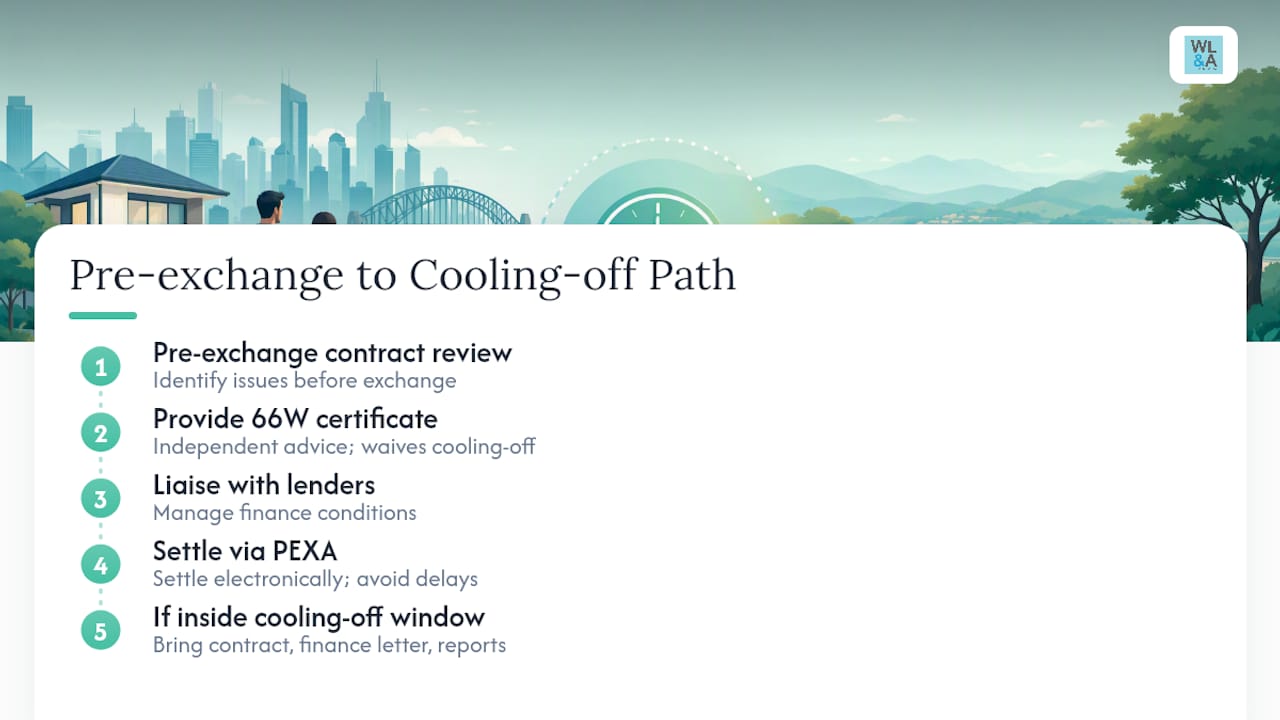
We also liaise directly with your lender throughout the course of the conveyance and run settlements through PEXA’s electronic platform, which keeps the handover from cooling-off to settlement moving without paperwork delays. If you’re inside a cooling-off window right now, book an urgent online or in-person consultation and provide us with your signed contract and any other relevant documents. Start with our conveyancing services page to see fixed-fee options and book a review.
This article is general information, not a substitute for advice from a qualified lawyer. Consult a qualified legal professional about your own circumstances before acting on anything here.
Sources
- Contracts and deposits when buying property in NSW
- Conveyancing Act 1919 – s66S (Cooling off period) | AustLII
- Buying property at an auction | NSW Government
- Conveyancing Act 1919 – s66T (No cooling off period in certain cases) | AustLII
FAQ
Do you legally have a 5-day cooling-off period in NSW?
Yes, for most private treaty residential purchases. It’s set at 5 business days by the Conveyancing Act 1919, or 10 business days for off-the-plan contracts, unless an exemption like auction or a 66W certificate applies.
Can the seller pull out during the cooling-off period?
No. The statutory cooling-off right belongs only to the purchaser. A vendor who wants to withdraw needs a different legal basis, such as a breach by the buyer or a specific term in the contract.
Does every property contract in NSW have a cooling-off period?
No. Auctions, same-day passed-in exchanges, and contracts where the purchaser has given a valid Section 66W certificate all carry no cooling-off right.
Can settlement be less than 30 days after exchange?
Yes, settlement timing is negotiated between the parties and isn’t fixed by law. A shorter settlement is possible if both sides agree in writing, but it leaves less time to finalise finance and searches, so get advice from West Legal & Associates before agreeing to a tight date.
This article is general information only and does not constitute legal advice. Property transactions involve significant financial and legal obligations specific to your circumstances. Contact West Legal & Associates for advice tailored to your situation before exchanging contracts.
Liability limited by a Scheme approved under Professional Standards Legislation.