In NSW, a registered proprietor is the person or entity whose name is formally recorded in the Register as the owner of an estate or interest in a specific parcel of land. That single entry carries real legal weight: it is the official answer to the question “who owns this property?” as far as the law is concerned.
Being registered brings several practical effects you should understand before you buy, sell, or inherit property in New South Wales:
-
Legal certainty. Your ownership is protected against most competing claims, a principle known as indefeasibility.
-
Priority. Registered interests generally rank ahead of unrecorded or equitable claims, even if those claims arose earlier.
-
An ongoing duty. The Register must be updated whenever your name changes, or when the property passes to someone else through sale, death, or transmission.
Key concept to understand next: indefeasibility under section 42 of the Real Property Act 1900 is the statutory rule that makes registration matter. The Register itself is maintained by state land registries, including NSW Land Registry Services and the Registrar‑General.
What is the Register, and why does registration matter?
Australia runs on the Torrens system, named after the South Australian who designed it in the 1850s. Instead of relying on a chain of private deeds passed hand to hand, the Torrens system keeps a single public record, the Register, as the definitive source of who owns what. If your name is on that record, you do not need to prove a century of paper trail to establish ownership.
Each property has its own folio, essentially a page or digital record within the Register showing the current proprietor, any mortgages, and other registered interests. NSW Land Registry Services administers this in New South Wales, while other states run their own equivalents, such as Landgate in Western Australia.
Landgate’s own policy guidance describes the Register as the structured folio system that registries use to record and update title information in practice, not just in statute.
Registry glossaries across the country define the term the same way. A registered proprietor is simply the person named in the Register Book as proprietor of an estate or interest in the land.
How does someone become the registered proprietor?
Registration does not happen automatically the moment you sign a contract. It follows a defined sequence, and until that sequence completes, you are not yet the registered proprietor, no matter how confident you feel about the deal.
-
Exchange of contracts. Buyer and seller agree on price and terms, and contracts are exchanged.
-
Settlement. Funds change hands and the seller hands over control of the property.
-
Lodgement of the transfer. The transfer document is lodged electronically, almost always through the PEXA platform in New South Wales.
-
Registration. The Registrar processes the lodgement and updates the folio, formally naming the buyer as the new registered proprietor.
Ownership can also change through transmission rather than sale. Death, intestacy, or bankruptcy each trigger different procedural steps, and lodgement priority matters here too. If two documents affecting the same title are lodged close together, the order of lodgement, not the order of signing, often determines who wins. Mortgagees are also entered on the Register when a loan is secured against the property, and caveats can sit alongside these entries to flag a competing claim before it is fully resolved.
What legal protections does registration actually give you?
Registration gives you far more than a name on a page. Under section 42 of the Real Property Act 1900, the registered proprietor’s estate is generally treated as paramount and indefeasible. That means your title stands even against claims that might otherwise have defeated an earlier, unregistered owner.
Indefeasibility is not absolute, though. A handful of exceptions can still unsettle a registered title:
-
Fraud, where the registration itself was procured dishonestly.
-
Misdescription of the land or boundaries in the folio.
-
Overriding equities in limited circumstances recognised by the courts.
-
A tenant already in possession, whose lease rights survive a change of registered proprietor.
-
Administrative or registrar errors that require correction.
Where a registered title is genuinely defective through no fault of the owner, statutory compensation schemes exist to cover the loss, reflecting the Torrens system’s promise that registration should rarely leave an innocent proprietor out of pocket.
Registered proprietor vs beneficial owner: what’s the difference?
The name on the folio and the person who genuinely benefits from the property are not always the same. Understanding that gap matters more than most buyers realise.
-
Registered proprietor: the legal owner named in the Register, holding the paramount title recognised by the state.
-
Beneficial owner: someone with an equitable interest, perhaps through a trust or informal family arrangement, that may not appear on the Register at all.
-
Joint tenants vs tenants in common: both are registered proprietors, but the way their shares pass on death differs significantly.
-
Mortgagee as proprietor: in specific circumstances the Registrar may record a mortgagee as registered proprietor, usually paired with a registrar caveat limiting them to exercising mortgage powers.
Pro Tip: Never assume a clean-looking folio tells the whole story. Ask whether a caveat, trust deed, or family agreement creates an equitable interest the Register doesn’t show, especially before agreeing to co-own a property with relatives or a partner.
If you are structuring co-ownership, our guide to joint ownership property sales in NSW walks through how these entries actually appear on title.
How do you prove you’re the registered proprietor?
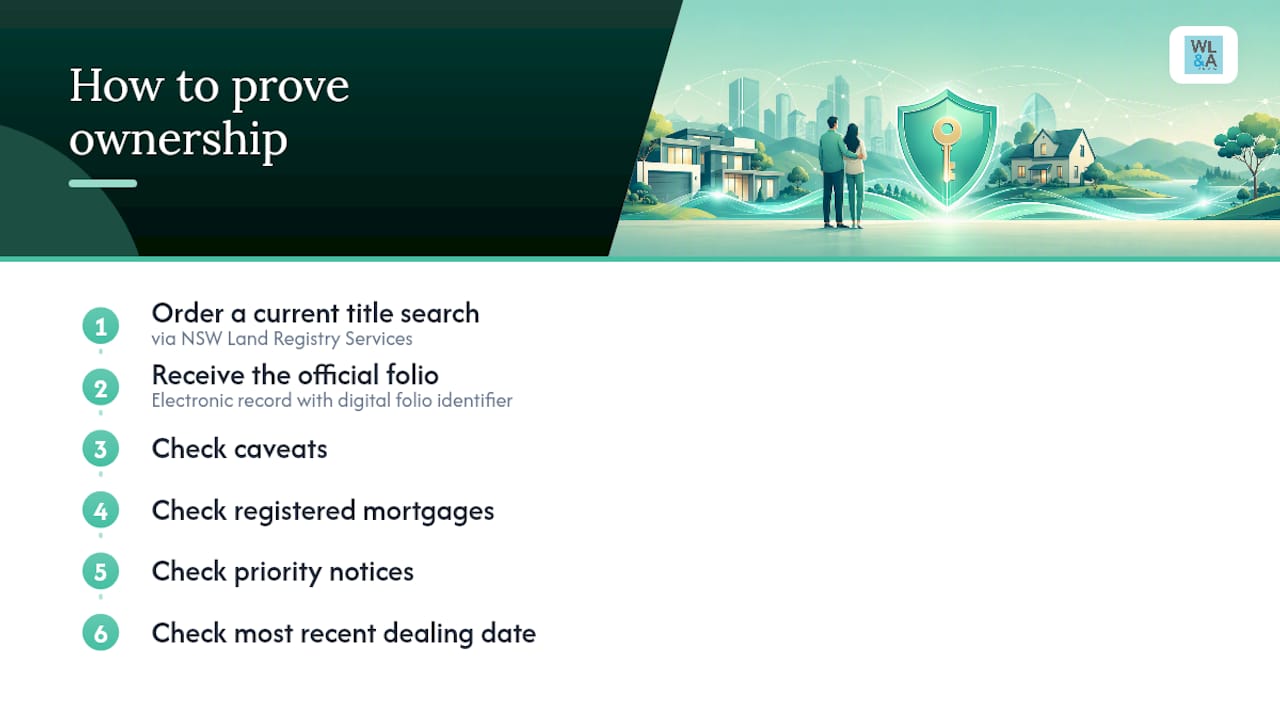
A current title search is the fastest, most reliable way to confirm registration. Ordering one through NSW Land Registry Services returns the current folio, showing the proprietor’s name, any registered mortgages, caveats, and recent dealings affecting the land.
Most titles in New South Wales now exist as electronic records rather than paper certificates, and an official search result, complete with a digital folio identifier, is the authoritative proof of ownership.
When you review a search result, check the caveats, registered mortgages, priority notices, and the date of the most recent dealing first. Those four details tell you almost everything about the current state of the title.
Our explainer on what a property title deed actually shows breaks down how to read a folio line by line.
How is the Register updated after a sale, death, or name change?
The Register is a living record, and several life events require you to formally update it.
-
Sale transfer: the outgoing and incoming proprietors sign a transfer, settlement occurs, and the transfer is lodged for registration, usually within days through PEXA.
-
Death (transmission): an executor or administrator lodges a grant of probate or letters of administration to have the estate recognised on the folio.
-
Change of name: marriage, divorce, or a legal name change requires supporting evidence before the Registrar will amend the entry.
-
Correction of errors: mistakes in a lodgement can be corrected, though priority may be affected while the correction is processed.
When should you get legal help with a registered proprietor issue?
Some situations call for professional legal advice rather than a DIY approach. Engage a solicitor or conveyancer when you’re facing:
-
A disputed title or a competing claim on the same land.
-
Suspected fraud affecting a registration.
-
A complex co-ownership split, such as dividing proceeds between tenants in common.
-
A transmission dispute between beneficiaries or executors.
-
Significant encumbrances, mortgage discrepancies, or an unclear caveat.
A solicitor can run title searches, prepare and lodge transfer documents, handle probate paperwork for transmission, and pursue a claim under statutory compensation arrangements if your title is affected by a registration error.
West Legal & Associates is PEXA certified, meaning every electronic settlement we manage is lodged and registered through the same platform NSW Land Registry Services relies on, giving Sydney clients a direct line between legal advice and the Register itself.
If you are entering a loan or guarantee arrangement, independent legal advice protects you before you sign anything tied to someone else’s mortgage.
Whether you are buying, inheriting, or untangling a co-ownership dispute, getting your name correctly and promptly recorded on the Register is the difference between a secure title and a costly argument later. West Legal & Associates handles PEXA-certified settlements and title matters across New South Wales, with both in-person and online consultations available. If you need certainty over a real estate transaction, our conveyancing team can review your position before you exchange contracts.
This article is general information, not a substitute for advice from a qualified lawyer. Consult a qualified legal professional about your own circumstances before acting on anything here.
Sources
FAQ
What does “registered proprietor” mean?
It means the person or entity whose name appears in the Register as the legal owner of an estate or interest in a specific piece of land, as recognised by state land registries.

Does proprietor mean the same as owner?
Not exactly. “Proprietor” on its own can describe anyone with a claim to the property, but only a registered proprietor holds the statutory protections of the Torrens system, including indefeasibility under section 42.
How do you prove you’re a homeowner?
Order a current title search from your state land registry. It will show your name as registered proprietor along with any mortgages, caveats, or recent dealings on the folio.
Do you really own your land in NSW?
If your name is correctly recorded as registered proprietor and no fraud, misdescription, or overriding equity applies, your title is generally paramount under the Real Property Act, meaning your ownership is about as secure as the law can make it.
This article is general information only and does not constitute legal advice. Property transactions involve significant financial and legal obligations specific to your circumstances. Contact West Legal & Associates for advice tailored to your situation before exchanging contracts. Liability limited by a Scheme approved under Professional Standards Legislation.