Once your condition has stabilised, the next step is to lodge Seacare form 4 with supporting medical evidence. Your employer then has 30 calendar days to decide the claim.
West Legal & Associates assists workers throughout Australia no matter where you are located.
Eligibility: legal meaning of ‘permanent’ and the WPI threshold
Under the Seafarers Rehabilitation and Compensation Act 1992, an impairment is treated as permanent when it is likely to continue indefinitely. Assessors look at how long the condition has persisted, whether further improvement is expected and what rehabilitation you have already undertaken. You should not apply for a permanent impairment payment out of sequence: you must first have an accepted primary workers’ compensation claim before a permanent impairment claim can even be considered.
Most claims need to reach a threshold before a lump sum is payable, and this is where the approved Guide becomes important.
- The general threshold is 10% whole person impairment, though some losses, such as certain finger, toe, taste or smell impairments, are treated differently under the Guide’s tables.
- Where you have more than one compensable injury, each is generally assessed on its own merits rather than lumped together automatically.
- A rating below the relevant threshold can still result in a 0% outcome under Edition 3.0 of the approved Guide, which is a real possibility claimants should be prepared for.
How to make a claim: evidence and a pre-submission checklist
The Seacare Claim for Permanent Impairment and Non-Economic Loss is available through the Seacare Authority and must be completed in full, including details of your accepted primary claim, before it can be assessed. A well-prepared claim generally includes a formal diagnosis, a medical opinion connecting the injury to your employment and an impairment assessment measured against the current approved Guide.
A practical sequence helps avoid unnecessary back-and-forth:
- Confirm your condition has reached medical stability before requesting a formal assessment.
- Check which edition of the Guide applies to your claim, since the version used affects how your impairment is scored.
- Obtain your WPI assessment from a suitably qualified medical practitioner who references the Guide’s tables directly.
- Assemble your treatment and rehabilitation records to demonstrate stability and support the causal link to your work.
- Lodge your claim with your employer and keep dated proof of lodgement.
Claims commonly get delayed when the clinical detail is thin, the wrong Guide edition is used, or rehabilitation documentation is missing, prompting a referral to an independent medical examiner before any decision can be made.
Assessment process: the approved Guide, WPI methodology and multiple injuries
Whole person impairment, or WPI, is the metric used to translate a medical condition into a percentage figure for compensation purposes. Assessments must follow the approved Guide to the Assessment of the Degree of Permanent Impairment.
The Seafarers Act takes an injury-based approach rather than a whole-condition approach.
- Separate compensable injuries are normally assessed and rated separately, following Comcare’s scheme guidance on multiple injuries.
- The combined values chart may apply in specified circumstances, but combined WPI can never exceed 100%.
- A rating that falls short of the relevant threshold can still be recorded as 0%, rather than simply being refused outright.
Claims involving multiple injuries or a pre-existing condition are rarely straightforward, so confirming the correct Guide edition and seeking a specialist medical report early tends to save time later.
Timeframes and outcomes: decision deadlines and what happens next
Your employer must make a determination within 30 calendar days of receiving a properly lodged permanent impairment claim, under section 73A of the Seafarers Act. Interim payments may be available in certain circumstances while the assessment is finalised, and employers can refer a claim to an independent medical examiner when the evidence on hand is not sufficient to decide it.
If the 30-day deadline passes without a decision, or your claim is rejected, a few immediate steps protect your position:
- Request written reasons for the decision called a Reconsideration request, or the lack of one, as soon as possible.
- Collect and copy every relevant record: claim forms, medical reports and correspondence with your employer.
- Note the time limits that apply to reconsideration or a review by the Administrative Review Tribunal, since these run from the date of the decision.
- Seek legal advice promptly if you are unsure which option applies to your circumstances.
Acting inside these windows matters more than almost anything else in the process, because a missed deadline can close off an otherwise valid claim.
How compensation is calculated and where to find statutory rates
Permanent impairment payments are calculated from your assessed WPI percentage, applying the formulas set out in Division 4 of the Seafarers Rehabilitation and Compensation Act and the approved Guide. Non-economic loss is calculated as a separate component, and a claimant can receive both a permanent impairment payment and a non-economic loss payment where liability is accepted for both.
- Statutory maximum amounts change periodically, so the Seacare statutory rates page is the authoritative source for the figures that apply to your claim.
- Interest can apply to late payments, so it is worth checking the timing of any payment against the statutory deadlines.
- Interim payments may be offset against the final lump sum once your claim is fully determined.
- If your WPI later increases by 10% or more following a further deterioration, there is a statutory mechanism to seek a fresh assessment and additional compensation for that increase.
Because these figures are reviewed over time, quoting a dollar amount here would risk being out of date the moment your claim is decided. Checking the official rates page before you negotiate a settlement is the safer approach.
When to get legal help
Get in touch with our office to assist you with preparing and lodging your claim for permanent impairment. Certain situations call for legal advice well before you reach a final decision. Disputed liability, complex multi-injury WPI questions, a tight appeal deadline, an outright rejection, or the possibility of an election to sue at common law are all reasons to bring in a lawyer rather than manage the process alone.
- A solicitor can audit your existing evidence and identify gaps before they become the reason your claim is delayed.
- Commissioning the right specialist medical report, matched to the correct Guide edition, is often the difference between a smooth assessment and a referral to an independent examiner.
- Preparing a reconsideration or tribunal application within the correct time limits protects your right to challenge a decision.
- Negotiating a lump sum and advising on whether to pursue common law action requires weighing up the statutory scheme against your broader options.
If you decide to seek advice, bring your claim forms, medical reports, correspondence with your employer, key dates and any rehabilitation records to your first meeting. West Legal & Associates’ Comcare and Seacare compensation page outlines the firm’s approach to these claims in more detail.
How West Legal & Associates can help with your Seacare claim
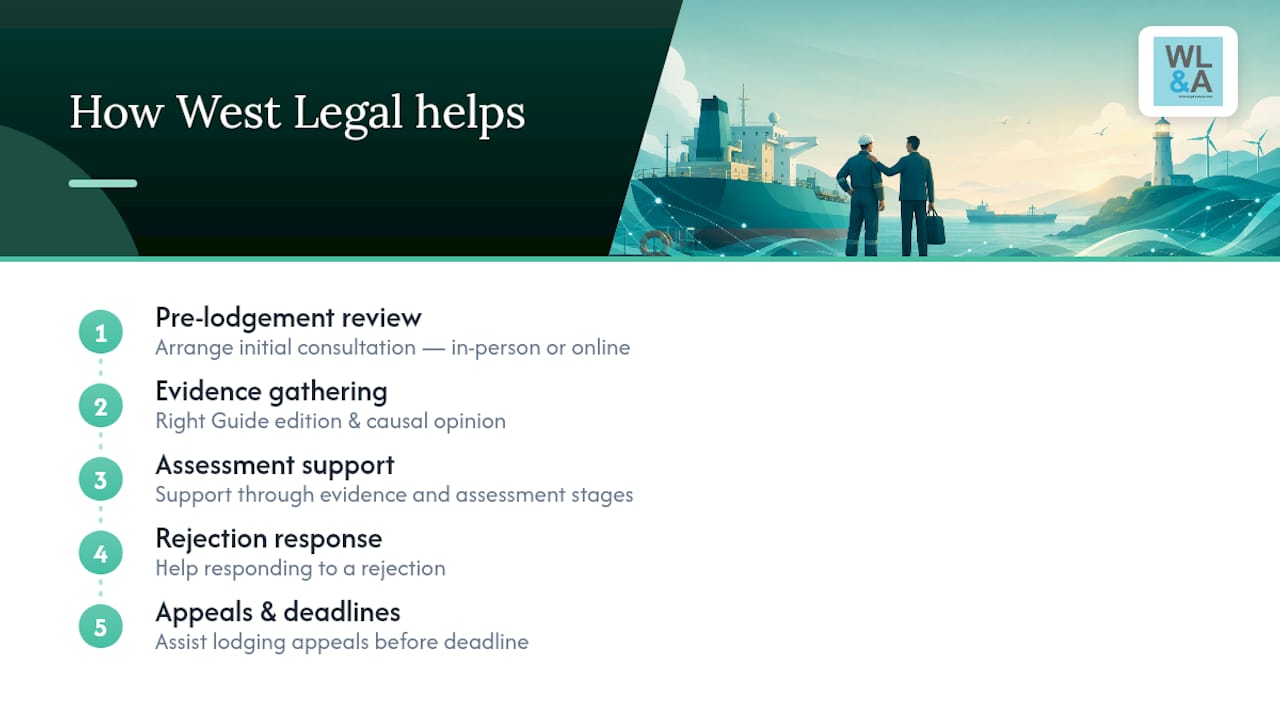
Claims for permanent impairment often hinge on details that are easy to miss under pressure: the right Guide edition, a clearly worded causal opinion, and a claim lodged before a deadline closes. Our lawyers can handle Comcare and Seacare compensation matters and offer both in-person and online consultations, so you can get advice whereever you are based around Australia or working a roster that keeps you away from land for weeks at a time.
If your claim involves multiple injuries, a rejection, or a looming appeal deadline, that is precisely the point where solicitor input tends to matter most. A Seacare permanent impairment page outlines support available for seafarers through the evidence, assessment and appeal stages of a claim.
If you would like your claim reviewed before you lodge it, or need help responding to a rejection, you can arrange an initial consultation with West Legal & Associates to discuss your circumstances and next steps.
This article is general information, not a substitute for advice from a qualified lawyer. Consult a qualified legal professional about your own circumstances before acting on anything here.
Sources
Before you lodge anything, it is worth having the right documents open in front of you.
- Long-term injury or impairment | Seafarers Safety, Rehabilitation and Compensation Authority
- Guide to the assessment of the degree of permanent impairment edition 3.0 – information sheet | Comcare
- Seafarers Rehabilitation and Compensation Act 1992 | Federal Register of Legislation
FAQ
What is the payout for permanent impairment?
The payout depends on your assessed whole person impairment percentage, calculated under the formulas in the Seafarers Act and the approved Guide, and the current statutory maximum amounts published by Seacare. You may also be entitled to a separate non-economic loss payment where liability is accepted for both components.
What is considered permanent incapacity?
Permanent incapacity or impairment is a condition that is likely to continue indefinitely, based on how long it has persisted, whether further recovery is expected and what rehabilitation you have already tried. Assessors under the approved Guide make this judgement as part of the WPI assessment, not as a separate legal test.