If you’re a seafarer injured on a prescribed ship, in the course of your employment, or during required training, you’re likely covered by Seacare workers compensation. Notify your employer in writing straight away, see a legally qualified medical practitioner for a certificate, and lodge the correct Seacare claim form. Official forms sit on the Seacare Authority website, and specialist legal help is available if your claim gets complicated.
Who is covered under the seacare workers compensation scheme?
Seacare workers compensation applies to seafarers employed on a “prescribed ship” engaged in trade or commerce, not every maritime worker automatically. The Seafarers Rehabilitation and Compensation Act 1992 covers injuries or illness sustained while on board your vessel of employment, but it extends further than most seafarers realise.
Coverage generally includes:
-
Time on board the vessel during your engagement, including ordinary rest breaks
-
Travel between your residence and the workplace, where that travel is part of your employment arrangement
-
Training required by your employer, even when it happens onshore
-
Injuries arising “in the course of employment”.
Not every maritime job fits the scheme. Coverage turns on the vessel’s status and the nature of your employment, and if your ship isn’t prescribed, or your role sits outside trade and commerce but also subject to an Enterprise Bargaining Agreement (EBA), Seacare may not apply at all. In that case, you’d generally need to pursue a claim through a state or territory workers’ compensation scheme instead, with different forms, insurers, and deadlines. Working out which regime governs your situation is one of the first things worth confirming, because chasing the wrong pathway wastes valuable time.
How do you make a Seacare workers compensation claim?
Getting the paperwork right early prevents most of the delays we see in Seacare claims. Follow this sequence:
-
Notify your employer in writing. Describe what happened, when, and where, and keep a dated copy for your own records.
-
See a legally qualified medical practitioner. Your certificate needs to state the diagnosis, link the injury or illness to your employment, and note your capacity for work.
-
Complete Seacare Claim Form (the workers’ compensation claim form) and attach your medical certificate and any incident reports. Claims must be lodged with your employer once you’ve obtained that certificate.
-
Submit supporting documents — payslips, roster records, and witness statements if others saw the incident.
-
Keep copies of everything. Every form, every certificate, every receipt, filed by date.
Tip: Photograph your claim form and medical certificate on your phone before you post or email them. If a document goes missing in transit, you’ll have proof of exactly what you submitted and when.
The most common mistake isn’t a missing signature, it’s a vague medical certificate and an incorrectly completed claim form. If the doctor doesn’t explicitly connect your condition to your work, your employer has grounds to query the claim before it’s even assessed. Ask your practitioner to be specific.
Contact our office should you require completing the claim form.
How long does an employer have to decide a claim?
Your employer is responsible for determining your Seacare workers compensation claim (and at times via their insurer). They must notify you of the decision in writing, and statutory timeframes apply to that determination, though extensions can be granted in more complex matters.
While reviewing your claim, employers typically draw on:
-
Your completed claim form and medical certificate
-
Any incident reports or witness accounts
-
Independent assessments by occupational therapists or approved medical experts, particularly where capacity for work is disputed
The written decision notice (known as a Determination) should state whether the claim is accepted or rejected, the reasons for that outcome, and your review rights if you disagree. If the deadline passes with no word, follow up in writing and keep a record of that contact. Silence may be considered a Determination decision, and chasing it in writing protects you if the matter later goes to review.
What benefits and supports can you access?
Once your claim is accepted, a genuinely broad set of supports opens up, though several require prior approval before you can claim them.
-
Medical treatment. Reasonable treatment costs are reimbursed once the claim is accepted, covering doctor visits, physiotherapy, and related care.
-
Attendant care and household services. These need approval before you start incurring costs, so apply early rather than assuming reimbursement after the fact.
-
Travel reimbursement. Reasonable travel costs to medical appointments are recoverable.
-
Property loss or damage. Compensation can extend to personal property damaged in the incident, such as protective equipment or personal effects.
The Seacare Authority publishes statutory rates for compensation, setting maximum weekly amounts for benefits including attendant care. These rates are reviewed periodically, so check the current figures before budgeting around a weekly payment estimate.
Because several supports demand approval upfront, the practical lesson is simple: ask before you spend, not after.
What are your rehabilitation and return-to-work obligations?
If you’re absent from work for 28 days or an absence of that length is expected, your employer must arrange an assessment of your capacity for rehabilitation. That assessment sits at the centre of the return-to-work process under the Seacare scheme.
Any rehabilitation program must run through a Comcare-approved provider, with your employer covering the program costs and reasonable travel expenses. A typical return-to-work plan includes:
-
A graduated schedule of hours or duties, building back to your normal role
-
Modified tasks that suit your current medical restrictions
-
Regular check-ins between you, your employer, and the rehabilitation provider
Tip: Engage with the rehabilitation process from day one, even if you feel it’s premature. Employers who use independent capacity assessments and see early, documented cooperation from claimants tend to resolve matters with fewer disputes.
How does permanent impairment compensation work?
Permanent impairment claims follow a different timeline to your initial injury claim. You generally lodge one only once your initial claim is accepted and your condition has medically stabilised, meaning further recovery isn’t expected.
Assessment uses the Guide to the Assessment of the Degree of Permanent Impairment under the Seafarers Act, which translates your medical condition into a percentage impairment rating. That rating drives any lump-sum compensation you’re entitled to.
To lodge a claim:
-
Contact our office to complete the appropriate Seacare permanent impairment claim form and arrange an Indepenent Medical Examination with an appropriate doctor.
-
Gather comprehensive medical evidence, including specialist reports addressing the specific body system or function affected
-
Attend any assessment appointments your employer or their approved assessor arranges
-
Keep every report and test result, since permanent impairment assessments hinge on documented medical detail, not just your own account of symptoms
Preparing this claim well takes time. Our permanent impairment guidance covers what strong supporting evidence looks like in practice.
What if your claim is refused or you disagree with the decision?
A rejection isn’t the end of the road. You can seek Reconsideration of the primary decision, and alternative dispute resolution is often available before matters escalate further.
-
Contact our office to request reconsideration in writing, addressing the specific reasons given in the decision notice
-
Use alternative dispute resolution where your employer or the Seacare Authority offers it
-
Act quickly. Review pathways carry their own deadlines, and missing one can close off options
Some cases call for more than a written request. Complex permanent impairment disputes, coverage arguments over whether your vessel or role falls under the scheme, and procedural breaches by an employer are the situations where specialist legal help earns its keep. At a first meeting, a lawyer will typically ask for your claim form copies, medical certificates, employer correspondence, and any incident reports you’ve kept.
West Legal & Associates has direct experience preparing and challenging Seacare and seafarers workers compensation claims, including disputed permanent impairment matters. Getting a second opinion on a rejection costs little compared to what a missed deadline can cost you and we can offer No Win No Fee options.
What records should you keep for a Seacare claim?
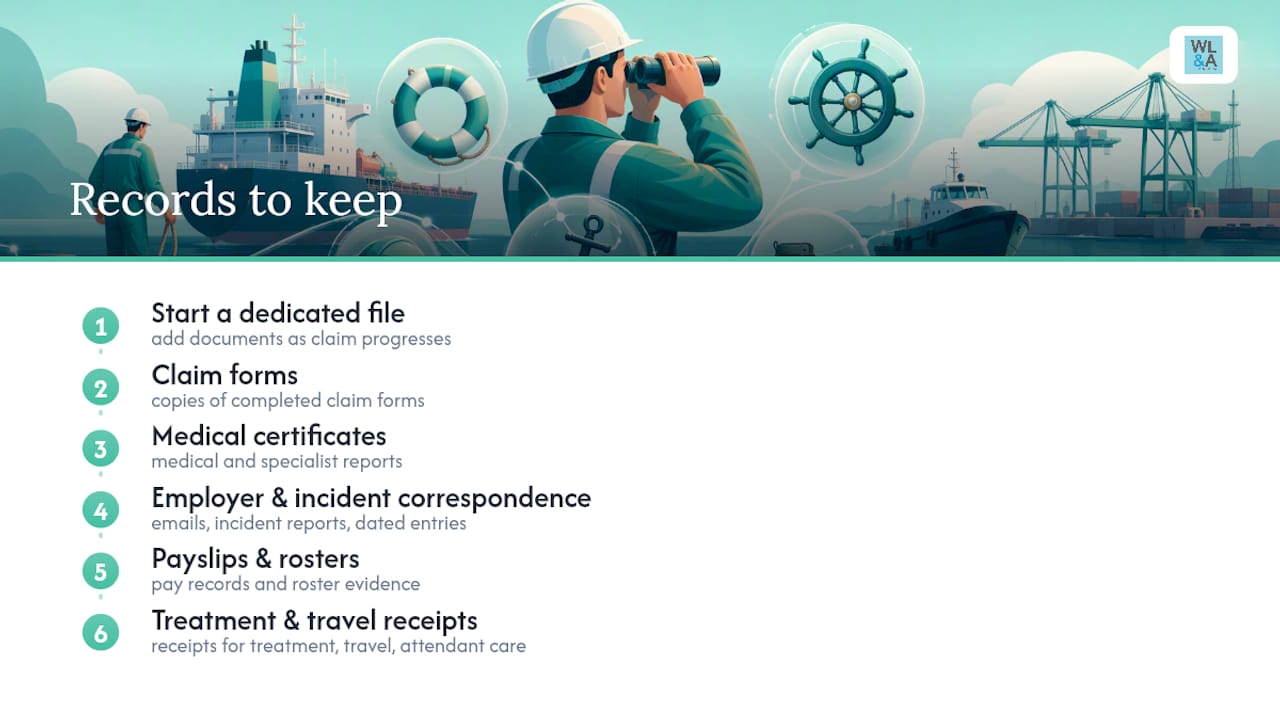
Good record-keeping is often the difference between a smooth claim and a drawn-out dispute. Start a dedicated file, physical or digital, the moment an injury occurs, and add to it as your claim progresses rather than trying to reconstruct the timeline later.
At minimum, keep copies of your completed claim forms, every medical certificate and specialist report, correspondence with your employer, and any incident or accident reports filed at the time. Payslips and roster records matter too, since they establish your employment status and earnings for benefit calculations. Receipts for medical treatment, travel, and any approved attendant care or household services should be filed as they’re incurred, not gathered retrospectively.
Date everything. If your employer’s decision arrives later than the statutory timeframe suggests it should, a clear record of when you lodged each document is what lets you demonstrate the delay. The same applies if a dispute later requires reconsideration or dispute resolution: assessors and lawyers alike will ask for a chronological record, and a well-organised file speeds up every stage that follows.
If you’re managing a rehabilitation program alongside your claim, keep notes from check-ins with your provider and employer too. These informal records often become important evidence if a return-to-work plan later becomes contested.
How West Legal & Associates can help with your Seacare claim
Seacare claims move fast once statutory deadlines start running, and getting specialist eyes on your paperwork early is often what separates a smooth claim from a drawn-out dispute. Our legal professionals can prepare and lodge Seacare claims, handle permanent impairment applications under the Seacare scheme, challenge unfavourable employer decisions, and negotiate settlements where a dispute can be resolved without a lengthy review process. Consultations may be available both in person and online, so distance from Sydney may not be a barrier to getting advice. For your first appointment, we require you to provide us with your claim form copies, medical certificates, employer correspondence, and any incident reports you’ve kept. If your matter involves a Seacare permanent impairment claim, provide any specialist medical reports too, since these drive the assessment. To get started on your seafarers compensation matter, contact West Legal & Associates to arrange a consultation and have your documents reviewed before your next deadline arrives.
Sources
FAQ
Does Seacare cover injuries during travel to and from work?
Yes, injuries sustained while travelling between your residence and workplace can be covered, provided that travel forms part of your employment arrangement under the Seafarers Rehabilitation and Compensation Act 1992.
How long does my employer have to decide my claim?
Employers must decide Seacare claims within statutory timeframes and notify you in writing, though extensions can apply in more complex cases; if you haven’t heard back, follow up in writing and keep a record.
What form do I use for a permanent impairment claim?
You lodge the Seacare permanent impairment compensation claim form, generally after your initial claim is accepted and your condition has medically stabilised.
What happens if Seacare doesn’t cover my role?
If your vessel isn’t a prescribed ship or your employment falls outside trade and commerce, you may need to pursue a claim through a state or territory workers’ compensation scheme instead.
When should I get legal help with a Seacare dispute?
Consider legal assistance as early as possible especially for complex permanent impairment assessments, disputes over whether your role is covered, or procedural issues with how your employer handled the claim. Consultations may be available both in person and online for these matters.
This article is general information only and does not constitute legal advice, Property transactions involve significant financial and legal obligations specific to your circumstances, Contact West Legal & Associates for advice tailored to your situation before exchanging contracts, and Liability limited by a Scheme approved under Professional Standards Legislation.
Liability limited by a Scheme approved under Professional Standards Legislation