A caveat on property in NSW is a statutory notice lodged on a land title that protects a person’s or organisation’s legal or equitable interest in that land. Registered with NSW Land Registry Services under the Real Property Act 1900, it prevents dealings such as sale, transfer, or further encumbrance until the caveat is withdrawn or removed. For buyers and investors in New South Wales, understanding property caveats NSW is not optional. A caveat discovered late in a transaction can delay settlement, trigger legal disputes, or collapse a deal entirely.
What is a caveat on property NSW explained?
A caveat is a formal warning recorded against a property title, telling the world that someone claims an interest in that land. The word itself comes from Latin meaning “let him beware.” In NSW, the Registrar General administers the title system, and a caveat lodged with NSW Land Registry Services is immediately visible to anyone conducting a title search.
The caveat does not prove ownership. It is a warning, not proof of title. Its sole function is to freeze dealings on the property until the claimed interest is resolved, withdrawn, or ordered removed by a court. That distinction matters enormously for buyers who discover one on a title they are about to purchase.

Who can lodge a caveat in NSW?
Only parties with a genuine legal or equitable interest in the land can lodge a caveat. Lodging without interest can render the caveat invalid and expose the caveator to a damages claim. The Real Property Act 1900 sets out the entitlement clearly.
Common parties who hold a caveatable interest include:
-
Purchasers under a signed contract of sale who have exchanged contracts but not yet settled
-
Mortgagees with a registered or unregistered mortgage over the property
-
Beneficiaries under a trust where the land is held on their behalf
-
Parties to a joint venture or option agreement with a documented interest in the land
-
Creditors who hold a charge over the property by court order
A caveatable interest must be a legal or equitable estate or interest in the land itself. A personal right, such as a contractual right to receive money, does not qualify on its own. The interest must attach to the land.
Pro Tip: If you have exchanged contracts to buy a property, consider lodging a caveat . It protects your position as purchaser and prevents the vendor from dealing with the title before settlement.
How to file a caveat in NSW: step-by-step
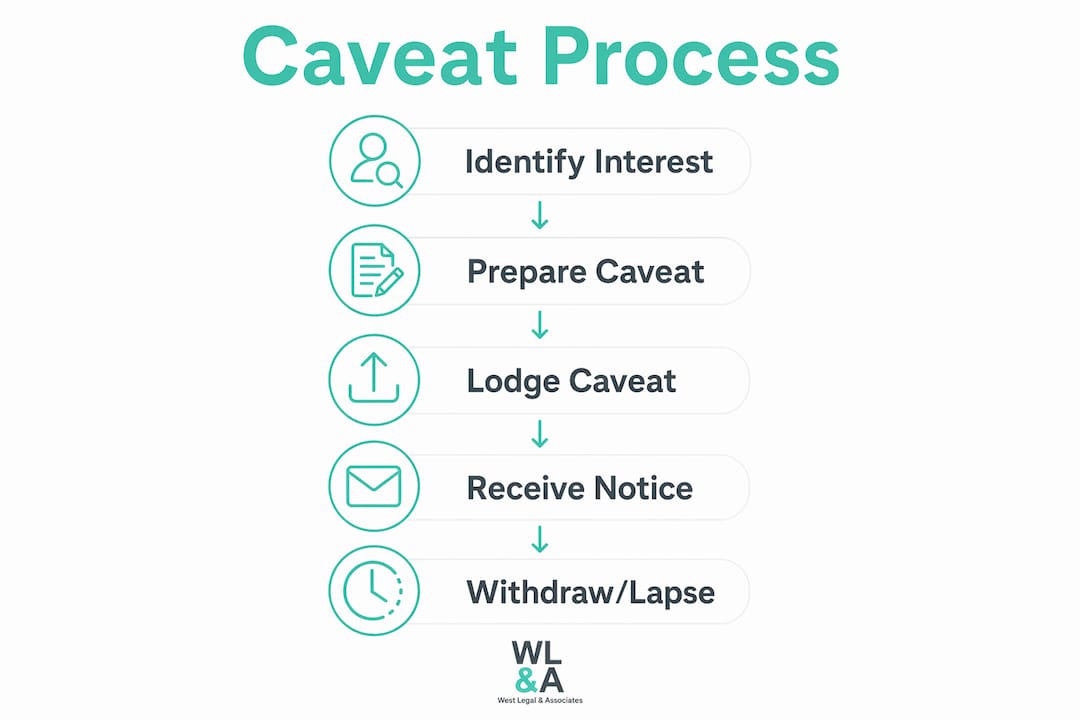
Filing a caveat in NSW follows a defined process. Accuracy is critical. Incorrect or incomplete forms can be rejected by NSW Land Registry Services, delaying the protection you need or be invalid.
-
Obtain the correct caveat form. The caveat form is issued by NSW Land Registry Services.
-
Complete the form precisely. You must identify the property by lot and deposited plan number, state the nature of the interest claimed, and provide the caveator’s full legal name and address for service.
-
Attach any supporting evidence.
-
Pay the lodgement fee. Fees are set by NSW Land Registry Services and are subject to change. Confirm the current fee before lodging.
-
Lodge with the Registrar General. Submit the completed form and fee to NSW Land Registry Services, through an approved electronic lodgement platform such as PEXA.
-
Await recording on title. Once accepted, the caveat is recorded against the title and takes immediate effect.
The Registrar must notify the registered proprietor that a caveat has been lodged. This gives the property owner the opportunity to respond or dispute the claim.
Pro Tip: Always engage a solicitor to prepare and lodge your caveat. A poorly drafted caveat that misstates the interest claimed can be challenged and removed, leaving you unprotected.
What impact does a caveat have on buying or selling property?
A caveat restricts registration of dealings on the title, including sale, transfer, and further mortgaging. Settlement cannot be fully effected until the caveat is resolved. That single fact has significant consequences for buyers, sellers, and investors.
Key implications for property transactions include:
-
Settlement delays. A caveat discovered at or near settlement can halt the transaction entirely until the interest is resolved or the caveat is removed.
-
Financing complications. Lenders maynot advance funds against a title with an unresolved caveat, as it clouds the security they are taking.
-
Buyer exposure. A buyer who fails to detect a caveat during due diligence may find themselves locked into a contract with no clear path to resolution.
-
Existing mortgages unaffected. A caveat does not stop the registered owner from drawing on an existing mortgage facility already in place.
For investors, a caveat on title signals unresolved interests or disputes that require professional handling to avoid transaction failure. Always conduct a title search before exchanging contracts. Review the exchanging contracts process carefully, because once you exchange, your obligations are locked in regardless of what a title search later reveals.
Understand the risk: A caveat is not a minor administrative issue. It is a legal claim against the land you are buying. Treat it as a serious red flag and seek legal advice before proceeding.
How does the caveat removal process in NSW work?
The caveat removal process in NSW offers several routes, depending on who is acting and why. Each route has specific steps and timeframes.
Voluntary withdrawal by the caveator
The caveator can withdraw the caveat at any time. Withdrawals must be signed by the caveator and lodged with NSW Land Registry Services using a Withdrawal of Caveat form. Once accepted, the caveat is removed and the title regains full marketability.
Lapsing notice by the property owner
If the caveator refuses to withdraw, the registered proprietor can issue a Lapsing Notice . The process then runs as follows:
-
The property owner lodges a Lapsing Notice with NSW Land Registry Services.
-
NSW Land Registry Services serves the notice on the caveator.
-
The caveator has a set timeframe to apply to the Supreme Court of NSW for an order extending the caveat.
-
If no application is made within the timeframe, the caveat lapses automatically and is removed from the title.
-
If the caveator applies to the Supreme Court, the court decides whether the caveat should remain or be removed.
Pro Tip: If you receive a Lapsing Notice and believe your interest is genuine, act immediately. Missing your window to apply, means losing your protection on the title.
Property disputes NSW explained through the lens of caveats often come down to this lapsing notice process. Most disputes resolve at this stage, either through negotiation or a Supreme Court order.
Key takeaways
A caveat on a NSW property title is a legal notice that freezes dealings until the claimed interest is resolved, and ignoring one at any stage of a transaction carries serious financial and legal risk.
| Point | Details |
|---|---|
| Caveat defined | A statutory notice on title protecting a legal or equitable interest in NSW land. |
| Who can lodge | Only parties with a genuine caveatable interest, such as purchasers, mortgagees, or trust beneficiaries. |
| Lodgement process | Complete the correct NSW Land Registry Services form precisely and pay the required fee before lodging. |
| Transaction impact | A caveat blocks settlement and financing until it is withdrawn, lapsed, or removed by court order. |
| Removal options | Voluntary withdrawal, Lapsing Notice by the owner, or Supreme Court order are the three available routes. |
How West Legal & Associates can help with property caveats
Dealing with a caveat on a NSW property title requires precise legal knowledge and fast action. West Legal & Associates assists buyers and investors across New South Wales with lodging, disputing, and removing caveats, as well as managing the full conveyancing process from contract review through to settlement.

Whether you have discovered a caveat on a property you are purchasing, need to protect your own interest in lodging one, or are facing a Lapsing Notice, the team at West Legal & Associates provides clear, direct advice tailored to your situation. Our PEXA certification means property settlements are handled efficiently through the electronic lodgement platform used across NSW. Contact West Legal & Associates through their conveyancing and title certainty service to get the right advice before your transaction reaches a critical point.
FAQ
What is a caveat on a property title in NSW?
A caveat is a statutory notice lodged with NSW Land Registry Services that records a person’s legal or equitable interest in a property and prevents dealings on the title until the caveat is resolved.
Who can lodge a caveat in NSW?
Any party with a genuine legal or equitable interest in the land can lodge a caveat, including purchasers under contract, mortgagees, and trust beneficiaries. Lodging without a valid interest can be invalid and expose the caveator to a damages claim.
How long does a caveat last in NSW?
A caveat remains on the title indefinitely until it is withdrawn by the caveator, lapses following a Lapsing Notice, or is removed by order of the Supreme Court of NSW.
Can a caveat stop a property sale in NSW?
Yes. A caveat restricts registration of dealings including sale and transfer, meaning settlement cannot be registered until the caveat is removed or withdrawn.
How do I remove a caveat from a property in NSW?
The caveator can lodge a Withdrawal of Caveat form with NSW Land Registry Services, or the property owner can issue a Lapsing Notice. If the caveator does not apply to the Supreme Court within the requisitite timeframe of the Lapsing Notice, the caveat lapses automatically.
This article is general information only and does not constitute legal advice. Property transactions involve significant financial and legal obligations specific to your circumstances. Contact West Legal & Associates for advice tailored to your situation before exchanging contracts. Liability limited by a Scheme approved under Professional Standards Legislation.