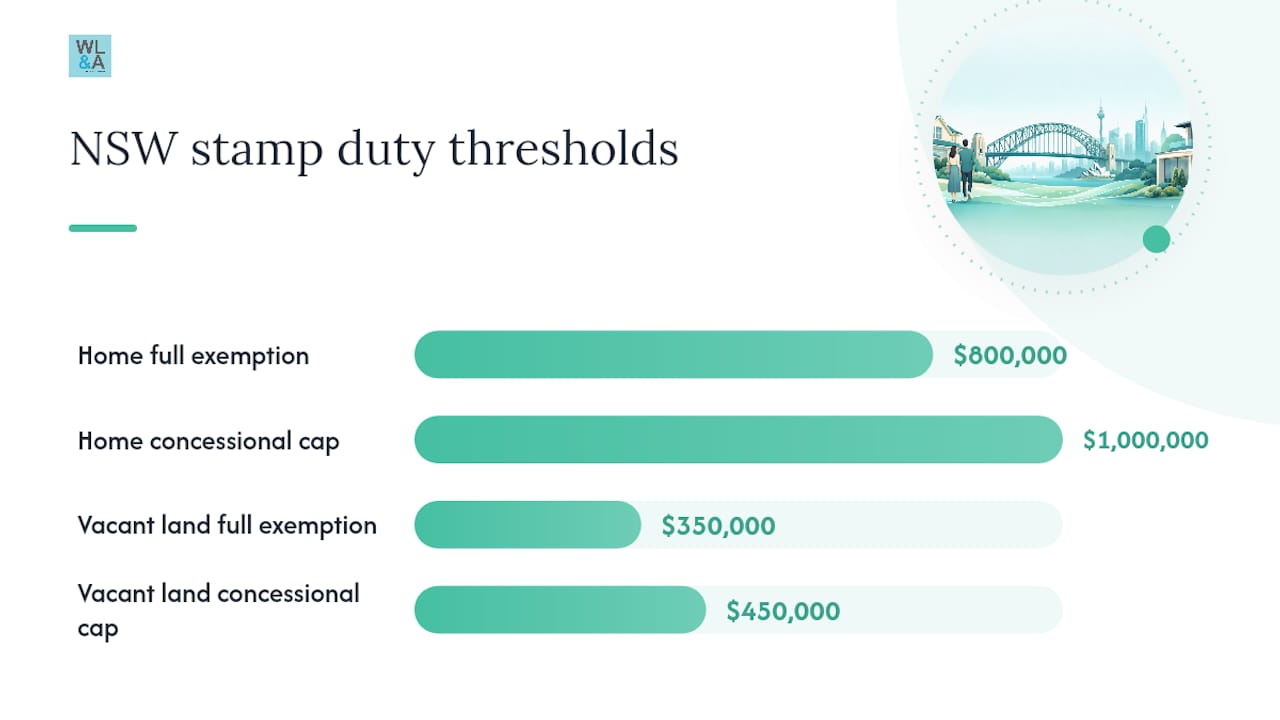
If you’re a first home buyer purchasing a property up to $800,000 in New South Wales, you generally pay no transfer duty at all. Buy within a defined higher price range, and you get a concessional rate instead of the full amount. Vacant land carries its own bands: full exemption up to $350,000 and concessions up to $450,000, under the First Home Buyers Assistance Scheme.
Outside first home buyer territory, several other exemptions exist. Beneficiaries inheriting property under a deceased estate often pay a flat $100 rather than the full ad valorem rate, provided the transfer strictly matches the will or intestacy rules. Transfers between spouses or de facto partners for a principal home can be exempt. Relationship breakdown transfers, primary production transfers between family members, and transfers to charitable bodies each have their own concessional pathways. One caveat cuts across nearly all of them: if any purchaser is a foreign person, surcharge purchaser duty can still apply even where the base transfer duty is exempt.
Before you get too far ahead of yourself, here’s what to check first:
-
Confirm the property’s purchase price against the FHBAS thresholds for homes or vacant land
-
Check whether every purchaser meets the citizenship, residency, and prior‑ownership tests
-
Gather title documents, the contract of sale, and (for estates) the will or grant of probate
-
Speak with a conveyancer or property lawyer before you exchange contracts, not after
Who Qualifies for Stamp Duty Exemptions in NSW?
The First Home Buyers Assistance Scheme sets the eligibility bar. At least one purchaser must be an Australian citizen or permanent resident. Every applicant must be over 18. Neither you nor your spouse can have previously owned residential land anywhere in Australia, and neither of you can have already claimed an FHBAS exemption on an earlier purchase, according to Revenue NSW’s eligibility criteria.

Prior ownership as a trustee or executor may not automatically disqualify you. If you once held property purely in a legal capacity for someone else’s benefit, rather than as a genuine owner, Revenue NSW treats that differently from personal ownership.
You also need to satisfy the residence test under Section 76 of the Duties Act 1997 (NSW), which requires you to move in and live there as your principal home within the first 12 months for at least 12 months.
Beyond FHBAS, several other categories carry their own tests:
-
Deceased estate beneficiaries must receive the property strictly in line with the will or intestacy rules
-
Spouses and de facto partners transferring a principal home between themselves under section 104B
-
Relationship breakdown transfers under section 68, which hinge on the timing and nature of the separation
-
Primary production family transfers, charitable bodies, and SMSFs meeting their specific structural conditions
Stamp duty snapshot: FHBAS gives a full exemption on homes up to $800,000 and vacant land up to $350,000, with concessional rates extending to $1,000,000 and $450,000 respectively, per NSW Government figures.
What Are the Property Value Thresholds for Stamp Duty Relief?
These bands apply to standard FHBAS purchases as of June 2026.
| Property type | Full exemption up to | Concessional rate applies | Approx. duty at midpoint of concessional band |
|---|---|---|---|
| New or existing home | $800,000 | $800,000 to $1,000,000 | Reduced ad valorem duty within the concessional rate band, increasing toward full duty near the top threshold |
| Vacant land | $350,000 | $350,000 to $450,000 | Reduced ad valorem duty, increasing steadily toward full duty near $450,000 |
Revenue NSW’s duty calculator gives you an exact figure based on your actual purchase price, contract date, and purchaser profile, and it accounts for adjustments the manual formulas often miss.
When Must You Move In, and What Happens if You Don’t?
FHBAS isn’t a one-time box you tick at settlement. You need to move into the property within 12 months of settlement, and then live there as your principal place of residence continuously for at least 12 months. Revenue NSW treats this as a genuine compliance threshold, not a formality, and failing to meet it can trigger a reassessment of duty plus interest.
The 12-month starts from settlement, not from when you sign the contract. Job relocations, family emergencies, and renovations that drag on longer than expected are the most common reasons buyers fall short.
Start building your evidence file from day one rather than scrambling for it later. Revenue NSW typically wants to see:
-
Utility bills (electricity, gas, water) addressed to you at the property
-
Electoral roll enrolment showing the property as your address
-
Driver’s licence or other official correspondence updated to the new address
-
A statutory declaration explaining any period you weren’t physically present, if relevant
Tip: If you know you’ll need to travel for work or care for a family member during your 12 months, document your intention to return and treat the property as your home before you leave. A short, well‑explained absence with supporting evidence is viewed very differently to an unexplained gap in occupancy records.
What Other NSW Duty Exemptions Exist Beyond First Home Buyers?
Plenty of NSW property transactions never touch FHBAS at all, and several of them carry meaningful concessions of their own.
The deceased estate concession is one of the most commonly used, and one of the most commonly misunderstood. When a beneficiary receives property under a will or through intestacy, the transfer can attract a flat concessional duty, commonly $100, instead of full ad valorem duty. The condition is strict: the transfer must conform exactly to what the will (or intestacy rules) actually says. Under section 65(12) of the Duties Act 1997, no duty applies to the initial vesting of property in the legal personal representative, but the concessional rate under section 63(1) only survives if the eventual transfer to beneficiaries matches the will precisely.
Spouse and de facto partner transfers of a principal home can be exempt under section 104B of the Duties Act, provided the property is genuinely the couple’s home and the transfer meets the section’s ownership and timing tests. Relationship breakdown transfers under section 68 work similarly but apply where a marriage or de facto relationship has ended, and the timing of the transfer relative to the breakdown matters.
Even where one of these exemptions clearly applies, surcharge purchaser duty operates as a separate layer. If any purchaser involved, even a minority interest holder, is classified as a foreign person, that portion of the transaction may still attract surcharge duty regardless of the underlying exemption.
What Happens if You Breach the Rules After Settlement?
Revenue NSW doesn’t simply take your word for it and move on. If you claimed FHBAS but didn’t move in within 12 months, or moved out before completing your 12 months of continuous occupancy, the exemption or concession can be reassessed. That means Revenue NSW recalculates the duty as if the exemption never applied, then adds interest on the unpaid amount from the original liability date.

When Should You Get Legal Help for a Stamp Duty Exemption?
West Legal & Associates handles exactly these situations day to day, across conveyancing, wills and estates, and deceased estate transfers, with PEXA-certified electronic settlements that keep the eDuties lodgement accurate and on schedule. If you’re working through a mixed-ownership purchase, our joint ownership guidance walks through how to structure the split so your exemption survives scrutiny. If Revenue NSW has already issued a reassessment, or you suspect one is coming, we can help you respond within the applicable time limits rather than losing the right to review.
The value of a second set of eyes here isn’t abstract. A contract clause, a will variation, or an ownership percentage that looks fine on the surface can quietly disqualify you from thousands of dollars in relief. Before you exchange contracts on a property where any of this applies to you, get in touch with West Legal & Associates for advice specific to your transaction.
Sources
For the exact wording behind any of the rules covered here, these are the primary references worth bookmarking:
- First Home Buyers Assistance scheme | NSW Government
This article is general information, not a substitute for advice from a qualified lawyer. Consult a qualified legal professional about your own circumstances before acting on anything here.
FAQ
Who Is Exempt From Paying Stamp Duty in NSW?
First home buyers purchasing a home up to $800,000, or vacant land up to $350,000, generally pay no transfer duty under FHBAS. Beneficiaries of deceased estates, spouses transferring a principal home, and several other categories can also access exemptions or concessions.
How Can You Reduce Stamp Duty on a House in NSW?
If you’re a first home buyer, buying below the $800,000 full exemption threshold or within the concessional rate band is the main legal route. Outside that, options depend on your circumstances, such as a deceased estate concession or a spouse transfer exemption, rather than any general discount available to all buyers.
Are Pensioners Exempt From Stamp Duty in NSW?
There’s no general transfer duty exemption specifically for pensioners or retirees downsizing in NSW, according to Revenue NSW. Any relief available to a retiree would need to fall under a separate category, such as a spouse transfer or deceased estate concession, not their pensioner status alone.
Can You Transfer Property in NSW Without Paying Stamp Duty?
Yes, in specific circumstances such as transfers between spouses for a principal home, relationship breakdown transfers, or deceased estate transfers made strictly in line with the will. Each pathway has its own eligibility tests, and getting the documentation wrong can turn an exempt transfer into one that attracts full duty.
This article is general information only and does not constitute legal advice. Property transactions involve significant financial and legal obligations specific to your circumstances. Contact West Legal & Associates for advice tailored to your situation before exchanging contracts.
Liability limited by a Scheme approved under Professional Standards Legislation.