What settlement adjustment means in NSW property transactions
Settlement adjustment is the financial recalculation that fairly divides property-related costs between buyer and seller at the time of settlement. Rather than one party bearing the full cost of an annual charge, the purchase price is adjusted up or down so each party pays only for the period they actually own the property. The document recording these calculations is called a statement of adjustments, or settlement adjustment sheet.

The core principle is straightforward. The seller is responsible for costs up to and including the settlement date. The buyer takes on liability from the day after settlement onwards. Because many property charges are billed quarterly or annually in advance or arrears, the split rarely falls neatly on a billing date, which is precisely why adjustments exist.
Common items adjusted in NSW property transactions include:
-
Council rates — annual charges levied by the local council, verified by a Section 603 Certificate
-
Water and sewerage charges — fixed access charges paid quarterly, plus metered usage paid in arrears
-
Strata levies — applicable to units and apartments, confirmed by a Section 184 Certificate from the strata manager
-
Land tax — where applicable, verified by a Section 47 Certificate from Revenue NSW
-
Rental income — on tenanted properties, rent is split between seller and buyer at the settlement date
The final adjustment amount is either added to or deducted from the purchase price the buyer must pay on settlement day.
Common settlement adjustments in NSW property transactions
Each adjustment item carries its own verification process, and understanding the differences helps you avoid surprises on settlement day.
-
Council rates are billed annually by the local council, typically from 1 July each year. A Section 603 Certificate confirms the amount owing and any arrears. If the seller has prepaid rates beyond the settlement date, the buyer reimburses the seller for that unused portion.
-
Water and sewerage charges have two components: a fixed service charge billed quarterly in advance, and a usage charge billed in arrears based on meter readings. The service charge is adjusted proportionally. Usage charges often require a special meter reading close to settlement to calculate the seller’s share accurately.
-
Strata levies apply to strata-titled properties such as units, townhouses, and apartments. A Section 184 Certificate from the strata manager confirms levies paid, levies owing, and any special levies raised. This certificate is the definitive source for strata adjustments.
-
Land tax is less common in residential transactions but becomes relevant for commercial properties or investment holdings. Revenue NSW issues the relevant certificate to verify liability.
-
Rental income on tenanted properties is adjusted so the seller receives rent up to the settlement date and the buyer receives it from the day after. The adjustment is based on the weekly or monthly rent stated in the lease.
For commercial properties, adjustments tend to be more complex. Outgoings, GST implications, and longer lease terms all require careful review, and the involvement of a solicitor experienced in commercial conveyancing is advisable.
How settlement adjustments are calculated and verified in NSW

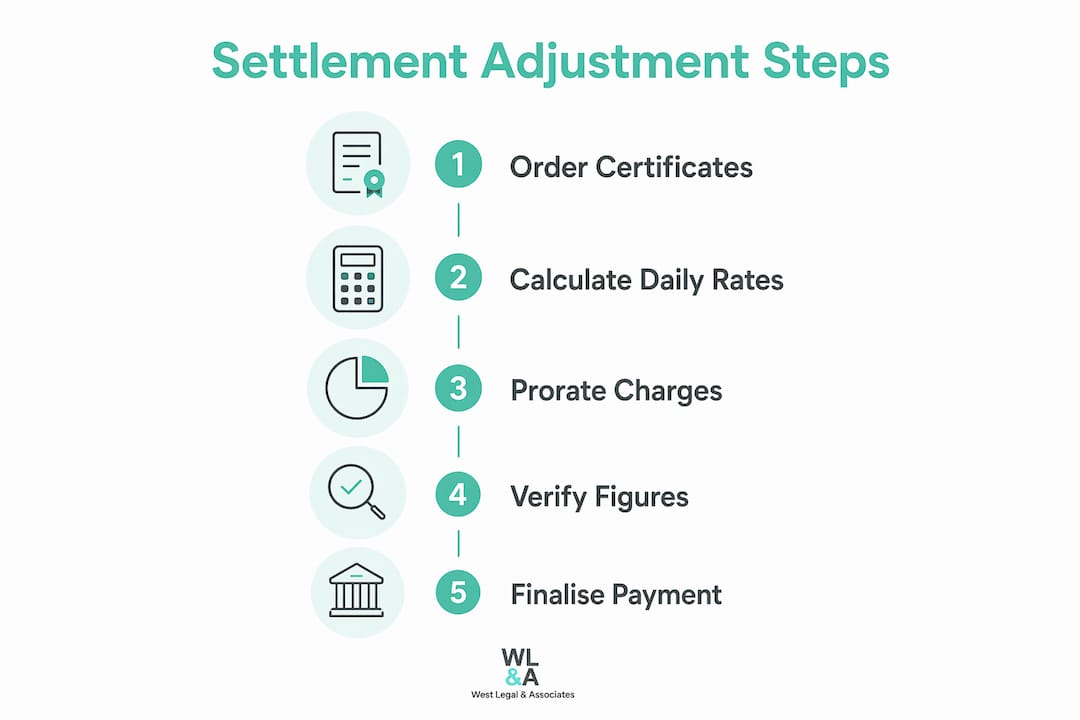
The calculation method follows a consistent formula across all adjustment items. First, determine the daily rate by dividing the annual or quarterly charge by the number of days in that period (365 days, or 366 in a leap year). Then multiply the daily rate by the number of days each party owns the property within the billing period.
For example, if annual council rates are $1,825, the daily rate is $5.00. If the seller owned the property for 200 days of the rating year before settlement, the seller’s share is $1,000. The buyer’s share covers the remaining 165 days.
Verification is just as important as the calculation itself. The buyer’s conveyancer typically prepares the draft adjustment sheet, drawing figures from statutory certificates. The seller’s representative then checks those figures against the same certificates before settlement proceeds.
Tip: Request all statutory certificates, including the Section 603 and Section 184, as early as possible in the conveyancing process. Delays in obtaining certificates are one of the most common causes of last-minute settlement postponements.
Early possession adds a complication worth knowing about. If a buyer takes possession of the property before the formal settlement date, the adjustment date shifts to the possession date, not the settlement date. This means the buyer becomes liable for rates and levies from that earlier date, and the adjustment sheet must be recalculated accordingly.
When do settlement adjustments happen, and what is the process?
Settlement adjustments are prepared in the weeks leading up to settlement, not on the day itself. The timeline typically runs as follows.
Once a settlement date is confirmed, the buyer’s conveyancer orders the relevant statutory certificates from the local council, water authority, and strata manager where applicable. These certificates take several business days to arrive, which is why early ordering matters. Once received, the conveyancer prepares the statement of adjustments and sends it to the seller’s representative for review and approval.
Both parties must agree on the figures before settlement can proceed. If there is a discrepancy, it is resolved through correspondence between the representatives, referencing the certificates as the authoritative source. For properties settling electronically through PEXA, the adjustment figures are entered into the platform and form part of the digital settlement process.
On settlement day itself, the adjusted figures determine the exact amount the buyer must transfer. The purchase price is either increased (if the seller has prepaid costs the buyer will benefit from) or decreased (if the seller owes costs the buyer will inherit). For a guide to the broader costs involved in selling, including adjustments, it helps to review these figures before exchange.
Disputes over adjustments are uncommon when certificates are obtained and verified properly. When they do arise, solicitors and conveyancers resolve them by cross-referencing the statutory certificates and, where necessary, seeking a formal legal opinion.
West Legal & Associates can manage your settlement adjustments
Property settlement in NSW involves precise calculations, tight deadlines, and certificates that must be ordered, verified, and reconciled before a single dollar changes hands. West Legal & Associates handles this entire process for buyers and sellers across NSW, with expert property settlement support available both in-person in Sydney and online for clients anywhere in the state.

West Legal & Associates holds PEXA certification, meaning electronic settlements are processed efficiently through the platform used by most NSW conveyancers and financial institutions. Every adjustment sheet is prepared with reference to the relevant statutory certificates, and the seller’s figures are verified before settlement proceeds. Whether you are buying your first home or selling an investment property, the firm’s clear communication and thorough approach means you know exactly what you will pay or receive on settlement day. Contact West Legal & Associates to discuss your property transaction before you exchange contracts.
FAQ
How do settlement adjustments work?
Settlement adjustments divide property costs like council rates, water charges, and strata levies between buyer and seller based on the settlement date. The buyer’s conveyancer prepares a statement of adjustments using statutory certificates, and the figures are added to or deducted from the purchase price.
What is the difference between an adjustment and a settlement?
Settlement is the legal completion of a property sale, when ownership transfers and funds are exchanged. An adjustment is a financial calculation within that process that ensures each party pays only for the period they own the property.
How soon after settlement do you get your money?
For sellers, funds are typically released on the same day as settlement, once the transaction is completed through PEXA or the relevant financial institutions. Electronic settlements through PEXA generally process faster than manual settlements.
Can anything go wrong on settlement day?
Yes. Common issues include missing or incorrect statutory certificates, discrepancies in adjustment figures, and funding shortfalls on the buyer’s side. Early preparation of certificates and thorough verification of the adjustment sheet by both representatives significantly reduces these risks.
This article is general information only and does not constitute legal advice. Property transactions involve significant financial and legal obligations specific to your circumstances. Contact West Legal & Associates for advice tailored to your situation before exchanging contracts. Liability limited by a Scheme approved under Professional Standards Legislation.